This post was written in Markdown, stored in a Supabase table called blog_posts, and pushed live by Claude, acting through a Model Context Protocol server we deployed an hour before it started writing. That part is on purpose. The story is the loop.
The brief
The old identity had gradients, glassmorphism, pink sunset heroes, and bright cyan used like wallpaper. Perfectly fine a year ago. No longer what the hub looks like in our heads. We wanted something quieter. Swedish-named palette. Typography doing the work. No glass, no blur, no "magic."
The model drafted
We asked Claude 4.7 to generate the identity. Five principles: restraint, honesty, precision, signal, technical. A palette with roles: bläck, kalk, skiffer, gränit, sten, hav, tegel. One accent colour, used as punctuation, never wash. A font: Geist. Layout rhythm. A list of things never to do, which turned out to be as useful as the things to do.
The draft was coherent on the first pass. Coherent isn't the same as correct.
Humans in the loop
The slow part was taste. We sat with the output, pushed back on the pieces that felt thin, tightened the voice, argued for lowercase in specific places, shipped what we were sure about and parked what we weren't. Claude drafted. We edited. Like any craft.
This is the step we don't want to skip. Speed is the boring part; judgement is where the hub earns its name.
Stored somewhere a model can read
We put the finished brand into BrandVibes.
BrandVibes is a brand asset platform that treats a brand as a single source of truth (colours, typography, voice rules, imagery guidance, design tokens) and exposes it as an MCP server. Not a PDF. Not a locked Figma file. A live endpoint that any AI tool can query.
From there, every tool we already use, Claude Code in the terminal, Cursor, Lovable, Claude itself, could read the brand in full on demand. When Claude wrote a new page component, it already knew the accent wasn't cyan anymore, it was hav. It already knew not to reach for shadows or gradients. The brand's opinions were in the loop from the first token.
The refactor
Then the vibe coders took over.
Every .aig-theme override, every typography rule, every archived _before/ route we kept alive so we could record the comparison. That's dozens of commits, reviews, and quiet pushes. Regressions caught. Heroes reshaped. A lot of "what if we tried", a lot of tasteful judgement calls you can't automate away.
Publishing this post
We wanted to write this post. Rather than open the Supabase dashboard, we built a second MCP server, the one that published the very page you're reading.
A Supabase Edge Function. Six tools: list, get, create, update, publish, unpublish. Deployed in minutes. The last step of writing this post was Claude calling create_blog_post with publish_now: true. The endpoint responded with an ID and a URL. You loaded the URL.
The Slack post
And then Claude shipped the news to our #all-aigothenburg channel via cowork, wrote the announcement, tagged sixteen vibe coders by name, dropped both MCP URLs inline, posted it. Another tool, another loop, no copy-paste.
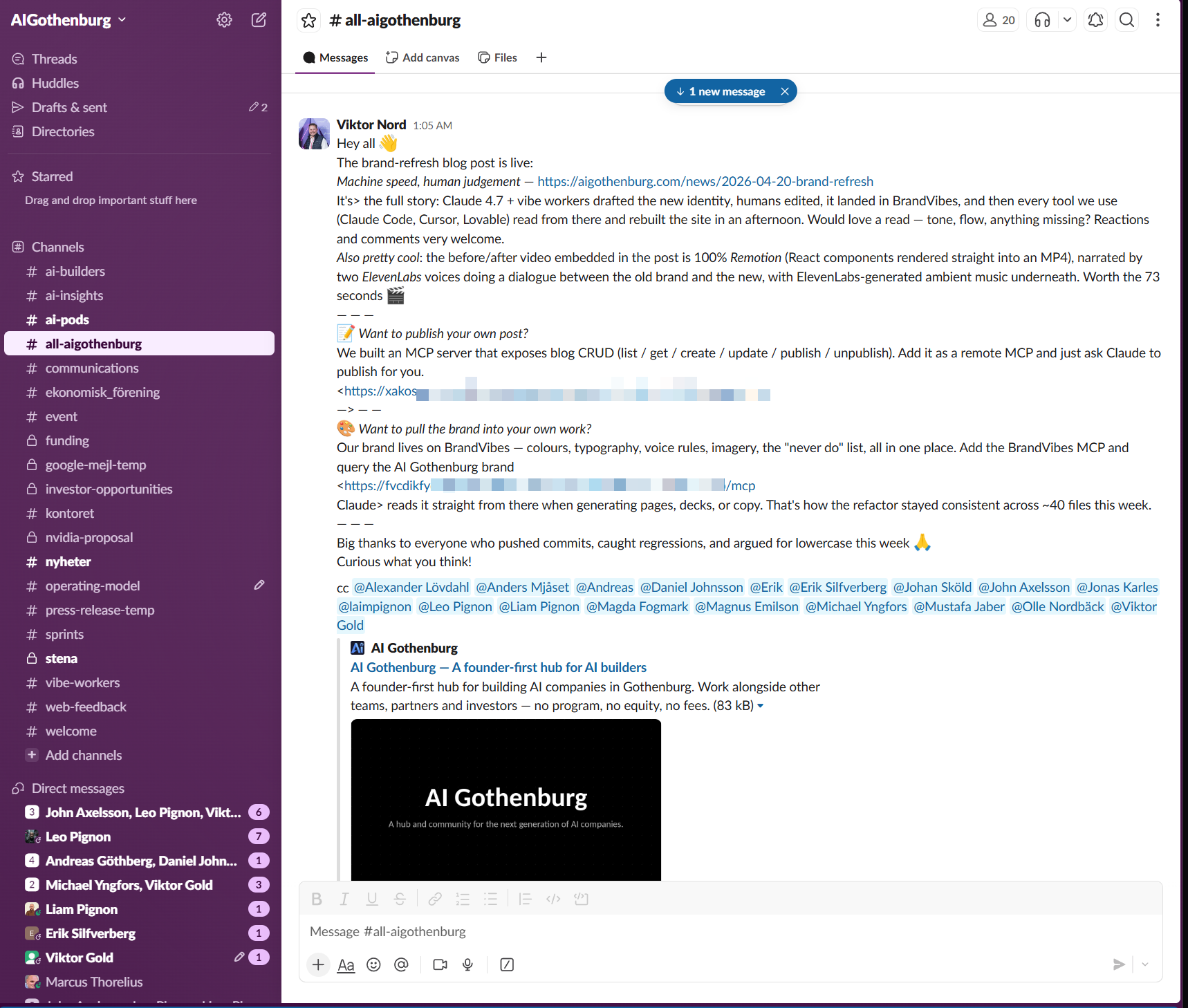
One brand. One blog post. One Slack announcement. Three different MCPs (BrandVibes for the brand, our own for the blog, cowork for Slack) all triggered by the same human asking in plain English.
Live as we preach
ai:gothenburg is a hub for founders building AI companies. It would be strange to tell founders the pace is changing and run the hub at the old pace. So we try not to.
The loop, in order:
- A model generated a brand.
- Humans shaped the details.
- We stored the brand somewhere a model could read it.
- Every downstream tool (editor, chat, CMS, messenger) pulled from the same source.
- The output updated the site, the deck, the launch video, this post, and the Slack announcement that said "hey, we shipped."
What used to be a multi-week coordination exercise across agencies, Figma files, and stakeholder meetings ran in an afternoon, with the taste and the final judgement staying with the humans. That ratio, machine speed, human judgement, is the part that scales.
The video
We also made a short before/after piece. Remotion for the composition: React components, real screenshots scraped from the _before/ archive routes and the current site, a palette morph, a typography swap, diagonal wipes between the three key pages. ElevenLabs for the two voices in dialogue (one for the old brand, one for the new, guess which is which) and the ambient music underneath. Written, narrated, and rendered in an evening.
It closes on one line: we leveled up the game.
Credits
- Claude 4.7 drafted the identity.
- The vibe coding community did every commit, regression, review, and quiet "no, tighter."
- brandvibes.ai held the brand and exposed it as MCP so every tool could read it directly.
- Remotion composed the before/after video from React components.
- ElevenLabs generated both dialogue voices and the ambient track.
- Supabase Edge Functions host the blog MCP that pushed this post.
- cowork posted the announcement to Slack and tagged the team.
Thanks, all seven.