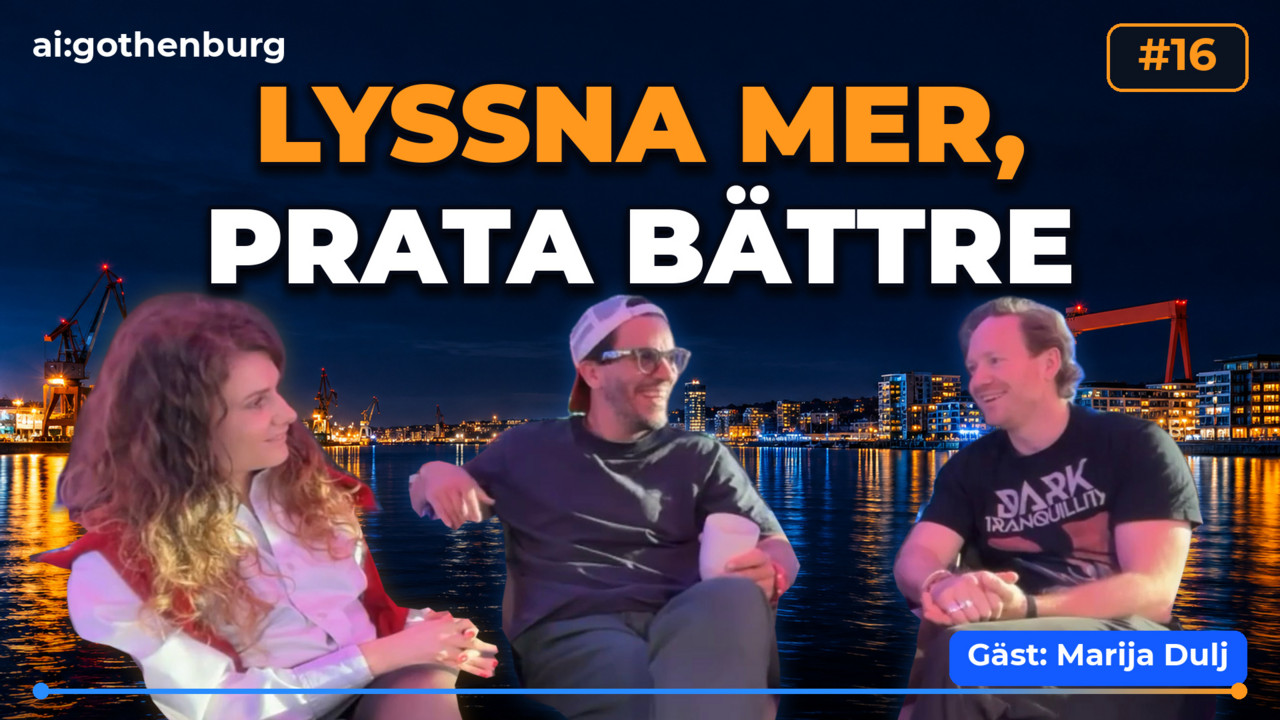
om avsnittet
Vad skiljer en pitch som landar från en som bara låter bra? Marija Dulj tränade talarna inför Gothenburg Tech Week. Nu sitter hon i studion med Christian och Viktor och vänder på frågan: hur bra är du på att berätta din egen historia?
Vi pratar om:
- Varför varje pitch börjar i problemet du löser, och varför det ska gå att förstå helt utan branschjargong
- Tal och skrift är två olika språk, och därför låter ett AI-skrivet manus ofta stelt från scen
- Personligt varumärke, förtroende och community när allt går att automatisera
- Christians egen resa: från 10 till 14 inlägg i veckan till 200 med agenter, och nästan en miljon visningar på Instagram
- Algoritmer, filterbubblor, AI-slop och varför kritiskt tänkande blir en superkraft
- Marijas brutalt ärliga råd till säljare och grundare: lyssna merGäst: Marija Dulj, grundare av The Pitch Architect i Göteborg. Retorik- och public speaking-coach med rötterna i Kroatien.
Mer om Marija: Instagram @thepitcharchitect, och thepitcharchitect.comVärdar: Christian Wederbrand och Viktor GoldFölj podden och skicka avsnittet till någon som behöver lyssna mer.
Vill du bli en del av Göteborgs AI-scen? Builders Community, personlig inbjudan via aigothenburg.com57.7008°N · 11.9469°E
- 00:00 Höstsol, TikTok live och hur Marija uttalas
- 01:22 Pitchträningen inför Gothenburg Tech Week
- 02:52 Retorik, konsthistoria och People & Culture
- 04:01 Från Kroatien till Göteborg
- 04:55 The Pitch Architect
- 06:41 Tal är något annat än skrift
- 07:53 Den perfekta pitchen börjar i problemet
- 09:24 Förklara det så att ett barn förstår
- 10:11 Svårast av allt: din egen historia
- 12:21 Allt är content
- 15:21 Förtroende när allt kan automatiseras
- 16:32 Våga vara dig själv
- 17:18 Christians brandresa
- 19:56 Nästan en miljon visningar och vad volymen gör
- 20:57 Sömn, agenter och livsbalans
- 24:41 Krokihistorien
- 25:42 Vem är du och vad gör du?
- 27:08 Community och nätverk som valuta
- 28:49 Algoritmer, filterbubblor och AI-slop
- 30:52 Kritiskt tänkande och fårflocken
- 33:43 Brutalt ärlig feedback: lyssna mer
- 35:24 Frågor som redan är färgade
- 37:26 Höra eller lyssna
- 38:39 Kommunikation är en färdighet
- 39:07 Den röda tråden
- 40:41 Fler kvinnor i studion
- 41:30 Agenterna jobbar medan vi pratar
transkript
Transkriptet är maskinellt och rättat i efterhand, så det kan finnas fel.
Visa hela transkriptet
[Transkriptet börjar cirka två minuter in i avsnittet. Inledningen finns inte i inspelningen som transkriptet bygger på.]
2:27Christian: The thing is, we talk a lot about belts, martial arts belts here. You do white, I do white belt, blue belt, and such. Yeah. In this case, regarding pitches, okay. It seems like you are a pro and a black belt in grilling. Yeah. People who is going to pitch. Yeah, is this something that you have been doing a long time?
2:51Marija: Kind of, I guess. Yeah, I studied art history and phonetics at the bachelor level, and then on a master level, I picked something called oratory or rhetoric, which is basically the public speaking today. And so I'm officially going by public speaking coach, and I did that gig for a couple of years in Croatia, where I'm from. Before I moved to Sweden, and then in Sweden I was working as a people and culture manager in a smaller startup. But you know, as in startups, you wear a lot of hats, which meant that I had support under me, I had customer success under me, I had the legislations guys or HSE and Q, and I was drilling the sales guys on the demos and. How to actually sell, right? So I run my mouth for business, basically. Yeah, yeah. We can we can call it like that.
3:52Christian: Definitely. From which part of Croatia?
3:56Marija: I'm from the countryside, not from the posh side Dubrovnik and you know Split or the places that everyone knows. No, I'm from the small countryside, a small place in the countryside called Slavonski Brod.
4:05Christian: So yeah. Oh, that's a little.
4:07Marija: That's a yeah, it's a long, it's a long way.
4:11Christian: Yeah, for sure.
4:13Viktor: And how did you end up here at AI Gothenburg?
4:17Marija: Again, I run my mouth for business. Yeah. So I met Michael at one of the events in September. I actually saw him quite a lot in the spring when he was kind of talking about AI Gothenburg, all around the Gothenburg events. And then in September we actually spoke for like 15 minutes. And then he mentioned that something's happening during the Gothenburg Tech Week, and that potentially, you know. Maybe I can help. So that's basically how that collaboration came into place.
4:55Christian: Regarding your handle in Instagram.
4:59Marija: Yeah, the pitch architect.
5:00Christian: The pitch architect. Yeah.
5:04Marija: Yeah. Yeah. So as said, I studied art history as well, and I'm very fascinated by architecture, and I love it. And the pitching part, I think I'm really good at because. I have the tendency to be able to understand what the tech bros, tech guys, developers are doing by asking a lot of questions, and then once I get that, I'm I'm very much willing to kind of help them put that into words that everyone can understand. So that's kind of how the name came up with.
5:36Viktor: It's a very good skill to have.
5:38Marija: Yeah, thank you.
5:39Viktor: Translating technical to business.
5:44Christian: To conversational regarding architecture. I was in Corfu last week. Yeah, nice. And I went to the Achilleion Palace.
5:58Marija: Enjoyed it?
5:58Christian: Yes, I really did.
6:00Viktor: What's that?
6:01Christian: It's a it's a it's a nice, really nice palace that's not very well taken care of now, I would say. But the thing is, they recorded James Bond there in the eighties. It's a very famous scene there. Wow, it's awesome. Cool, really cool architecture.
6:18Marija: Yeah, exactly. I'm not a fan of today's architecture, for instance, because it's so stripped of everything. It's just concrete and you know, windows. So yeah, doesn't tell a story, right? And that's kind of what I do: tell a story or help people to tell their story.
6:35Viktor: It's it's actually spot on. You need to tell a story wherever you go. It's going to be even more important moving forward.
6:41Marija: That what's your story and what's this business story or yeah your corporation or whatever right yeah exactly storytellers that's that's something that I think that AI has it but the important part that I'm seeing as a kind of gap to fill is the fact that AI is a written language I mean you can use it in the voice but it when you're speaking it's completely different than when you're writing. Your thoughts are kind of constantly coming up, right? And then you're trying to, oh, maybe I should say that. Maybe I should say that. It's just, you know, the inner monologue. And then that can confuse you when you're supposed to talk in front of, for instance, what we had here, 70 people that night. And then if you don't know how to phrase it, or if you don't know how to react in that exact second, everything can go down the drain, right? Yeah, sure.
7:33Viktor: So if we wanna educate or help anybody out there doing the perfect pitch. Where do you start? And then you can do a perfect pitch of yourself, an introduction, yeah, or your business.
7:45Marija: You can pick. Yeah, I think that. I mean, personal is super hard. I think without getting to know the person. Business, I think. I mean, most of the advice is always go to like, what problem are you solving, and that is important. But it's also important that. That problem that you're solving, everyone understands what problem you're solving, right? We had a lot of pitches here that, when I first heard their pitches, it was like, "But what's the problem?" Like I understand the problem in your terminology, but common folks don't understand that, right? And that's the whole point, because they're the ones that are supposed to buy it of sorts or invest in it or something like that.
8:31Viktor: And the final pitches that were presented usually led with a story.
8:35Marija: Yeah, exactly. Because you need to exactly. I mean, when it comes to talking to anyone, you need to profile the audience. Now, I mean, you two are kind of my audience, but we also have an audience of a lot of people, right? So we're talking very generally. We're not going into specifics of sorts. But when you're talking in front of, for instance, investors. You knew that those are investors, so not necessarily everyone has the same background or education or whatever. But we knew one thing: they have money, and they want to put that money into companies. Now, if they understand what problem you're solving, with their knowledge of industry of the world, they can potentially see, okay, that's a gap where I'm potentially either not having tapped in, or I have a lot of connections, which means that I potentially have a lot of clients, right? So, if you can manage to explain what are you solving in plain language to literally a five-year-old, seven-year-old, you shouldn't have any issues in your life, right?
9:39Christian: Oh, no issues in my life!
9:42Viktor: Wow, that's a big promise in my regard.
9:44Christian: Regard sleep and such.
9:47Marija: No, but I mean, it's easier than to talk to anyone, right?
9:50Viktor: If you know how to talk to a five-year-old or seven-year-old.
9:53Christian: Yeah, for sure, for sure. But one thing, you help people. Tell their story in a better or more perfect way.
10:06Marija: I wouldn't say perfect.
10:07Christian: No, not perfect. Yeah, but yeah, nothing is perfect.
10:09Marija: Yeah, exactly. But the thing is.
10:11Christian: How good are you in telling your own story?
10:17Marija: I think that's what I call like a PhD or an expert issue, because, for instance, we have Christian here, right, with the PhD, and. When you know something so well, it's really hard to put it into words, and it's really hard to kind of do the overview of something. So when it comes to my own story, I'm not sure how good I am in telling it. I mean, there are so many things that people don't know about me.
10:44Viktor: So everybody out there can review Marija in the comments.
10:47Christian: Grill me. No pressure.
10:50Marija: No pressure, but grill me, please, you. But yeah, I mean. When you're an expert in something, it's really hard because you know the constraints of this, constraints of that. You know the research, you know the background story, you know how something developed, and how to put that into you know two minutes or three minutes can be really really hard.
11:06Viktor: It's like having an AI agent reviewing the same talk it wrote. Yeah, yeah, I like it. Yeah.
11:13Christian: It's very good.
11:14Marija: Yeah, but it's also like, which part do you actually say? Yeah, I don't know. But when it comes to my own story, I, I mean. I've done some crazy stuff in life, but you know, currently I'm here. I'm a public speaking coach, and that's my gig. And you know, I do have some academical background. I have some experiences to support that. And let's see how it goes.
11:32Viktor: Give us a crazy story then. Everybody wants to hear a crazy story.
11:36Marija: I don't know. Share yours and then.
11:38Christian: What level are we at? Yeah, exactly. I had wild dreams in my twenties. So hold my beer. Okay.
11:47Viktor: It's a different podcast.
11:49Christian: Regarding, regarding, Truly, when it comes to storytelling, one thing is when they stand up on stage. Yeah. You have coached them and have them and certain trained them, and they say stand, stand here in front of investors. Yeah. Okay. Yeah. But this, like you said, it's just here and for that moment. What we did, we filmed and we took pictures of everything because want, of course, to spread this so many more people will see it. And the thing is, what happens after an event or a story, which is being told, this is what we're doing now. We are recording these stories so we can share them to more people. So more people contact you for potential help coming up with the pitches and whatever. But the thing is, it's important how in your work with the client. Do you take it further on when it comes to the social media part? How you should be work with what we actually create here because everything is content. Yeah, you need to really use what you do because otherwise it's just here for the moment, right?
12:58Viktor: Yeah, you can have the best product in the world if you can't sell it, nobody will buy it anyway. So exactly, content marketing, sales, all these things.
13:06Christian: So you have my question now is: Do you have that? Channel in your business.
13:12Marija: Yeah, but it also depends on the clients that is approaching, right? For this particular event, we knew what was the point. You had a bunch of startups that we wanted to show to the investors as the hub in terms of like, look, we have really nice things here going. Come and check it out. So in that particular moment, you need to think about the investors, and you need to also think about showing what the hub is actually doing. So I was going from that standpoint, but when you're Working with clients in terms of one-on-ones with public speakers, that's a completely different thing because it depends: Are you building a brand of yourself as a, you know, I'm future keynote speaker or whatnot, and I want to make money of it, or I want to be someone who is just talking out there about, you know, entrepreneurship or whatever? I'm not interested in money because those are also two different strategies. So every public speaking has a strategy. This is more like. Conversational, informative, whatever type of a thing. But there are so many others in terms of selling, educational, Comical kind of, right? But when it comes to companies, definitely you do need to work with marketing in terms of positioning and sales in terms of positioning. How to actually tell a story and what is our ideal customer and how to kind of tap into that world and how to. Make them hear us. So yeah, I do consider all of those things when I'm talking to someone. So the conversations the initial conversations can be quite long and exhausting in terms of me asking a lot of questions, because as both of you know, I ask a lot of questions. But that's only for me to kind of build the story that I'm going to or build the approach that I'm going to tackle this problem with.
14:55Christian: So yeah. Life. The thing is.
14:59Marija: I didn't answer your question.
15:00Christian: No, the thing is, we call it a political answer. Yeah. So no problem. But the thing is, I like how you resonate. Yeah. Think. Yeah. "resonera" in Swedish.
15:11Marija: Oh. Is that? Yeah, they're okay.
15:13Viktor: Reasoning.
15:14Christian: Yeah. Reasoning. Yeah. I don't know. Thank you. No, but the thing is, when we meet a lot of people, of course you do too. The thing is, a lot of people don't understand. Really don't understand the value of a personal brand or brand, yeah, yeah. But that's extremely important. And you talked about sales. Of course, in the long run, it's of course about sales. But the thing is, you need to build trust. Yeah. Yes. Credibility in everything you do. Yeah. No, but that is but part.
15:45Viktor: And always and in this in this particular age we're in, you have you have a critical path. To your to building your trust and to building your channels, you we're in a world where anybody can do anything automatically, more or less. It's going to be crowded very quickly. So you have already crowded. I mean, this is not crowded. Okay. It's going to be crazy crowded. Yeah. Okay. So you have like a couple of months now to really build what your platform in marketing. You can talk about that later on in sales, in trust, in community network, all these things. So it's super crucial to not sleep on this. Yeah. To not sleep on learning how to build. We use we talk about agents all the time. Don't sleep on this train. Don't sleep on the on building your trust. And what you are very good at, Christian, to give you some credit, it's you're out there being you. You do you do your podcast, you do your thing, and you're not excusing yourself for anybody, and it's real. And on top of that content, you can build so much more. So if you have, if you if you are you, your personal brand, people will resonate with you. Not everybody. Yeah. I mean, people that don't like you, where is his shoes? Yeah. Whatever. They won't follow you. No. But other people will. And the world is enough with enough people to like your fit.
17:09Marija: World is not beige.
17:10Viktor: Right? We need some color. Yeah. We need some color. Yeah. And. And yeah, so what's the latest status? And you, you reached out on podcast like yeah, one week or two week ago. You were so happy. You had like yeah, one or two Instagram reels or yeah.
17:29Christian: Yeah, regarding viral things. Yes. Yeah, but the thing is, because I always talked about I started building my brands in 2009, I think or 2010, and I actually gonna put out on. A post tonight actually because I in Facebook that ah sixteen years ago yeah yeah because then it helps you recreate content then you get new thoughts and I build my own brand at that time it was a fighting brand with yeah fighting brand because I'm a martial artist and I thought about I need my own coat you know I need my own gloves I mean. I started, and the thing is, this is 2009. I registered the name, and in 2010 we got the first samples. It took forever to make the make the samples. I had a friend making doing the website over here. I had someone over here making the logo. It took forever, and I was like. Damn! I need to do posts about this regarding brand because today you can really, really start a brand over a weekend.
18:41Viktor: Yeah, and iterate if it works or not.
18:43Christian: Yeah, immediately. And I because I really want to add value to everybody out there because then they can test it, try it, all the things that I have done and regarding brand, then because then it's very, it's very important. I mean, with brand. So when it comes to Now AI and posts on social media because it's free. Yeah, still free. That's amazing, I would say. So now, when I have built a lot of agents and I know how to do it since three weeks now. Yeah, I have my statistics, which you love. Yeah, I do. So the thing is, I've gone from 10 to 14 posts a week, which I was wow, that's a lot. Now I'm going for 200 this week. Okay. Posts. The thing is, and then people ask me, why are you spamming? But the thing is, I am not spamming because the algorithm, you know, and everybody doesn't see everything. And the thing is, I run from I'm. Over a million views only on Instagram, and I don't have that many followers, you know. And the thing is, we got in the viral things. I have since we talked. I have two more things that have gone viral. And how about that? The thing is, why? Yeah, because I have a lot of posts on all platforms. And the things I have a lot of content.
20:19Viktor: That is true.
20:20Christian: Yeah, for sure. But the thing is, you don't have to go bananas like me, maybe. But the thing is, I see now what it has done in these three weeks. Give me a month more or half a year. Yes.
20:37Viktor: Yeah. Can you promise on the on the live stream that you help me set this up till next week?
20:42Christian: Yeah, for sure. I also witnesses. Yeah. So you can be like the father from the first. Account. I work with accountability, so for sure. But the thing is, you have to also. Put aside the time to do it. Yes. Yeah. Okay. And that's on you. That's not on me.
21:01Marija: Since you're sleeping so well, I think. Yeah.
21:03Viktor: I mean, I can cut somehow more hours.
21:06Christian: For sure. You won the sleeping contest today. I would say because I had five hours this time.
21:12Viktor: But you have. Yes. Yes. Yeah. Didn't we tell Marija's first comment? She saw me this morning. Yeah. Oh, Viktor, you look terrible.
21:21Christian: What have you done?
21:22Marija: You look terrible. What? Did I use terrible?
21:25Christian: Something similar. No, it felt like it. Yeah, yeah, yeah.
21:28Viktor: I actually slept nine hours and forty-two minutes, according to my Fitbit here.
21:32Marija: Yeah, but the night before you slept for three hours.
21:34Christian: We have a we have a word in Swedish called.
21:39Marija: Say it.
21:39Christian: Okay, I will say it. When you said that to Viktor, I was like standing next to this terrible thing, which you said. I was like. I am being secondary kränkt here.
21:55Viktor: Okay. I have never heard that in Sweden.
21:57Christian: So now you know yourself. So I, I felt kränkt because crazy kränkt white dude. Yeah. No, that's a word I really don't understand and I don't like. So, but I, I wanted to share it.
22:14Viktor: Okay. So anything between three hours and nine hours is awesome. I would say.
22:17Christian: So you had three hours.
22:19Marija: No, no, no. I had like six last night.
22:22Christian: Oh, sorry, six hours. Yeah, yeah, okay.
22:24Viktor: But there is like the AI vampire thing trend going right because since you tap into this amazing technology, you can build so much so fast and get the leverage, the scalability of your hours so much. It's hard to switch off. We talked about this before as well. It's like if you're a gamer, you're very tapped into your game. It's like the same. Or in social media, you just keep on scrolling. You can't stop. Just one more prompt, and I mean, I feel that personally. It's it's but it's very fun, very engaging, very educational. But it's also okay. Touch grass. Ooh, it was nice sun today. Can we sit here on the stage instead of in the black coat? Darker.
23:12Christian: Perfect. Perfect. Very good. But the thing is, have you have you met Liam? Have you met Leo? Right now, before. His son Liam. He used a word that I really really connected with, and it's it's not very good I would say, but it's very important to talk about. It's what you talk about now: agent burnout. Okay. Because when you go all in, no, it's like it's like Kurt Cobain, right? It's better to burn out than to fade away. Burn out and fade away. But the thing is. In this case, it's not good at all because if you go all in on something, and in this agent world we live now, it's very, very easy to go too deep down the rabbit hole, and it consumes you. Yeah. And the agent burnout, I really do think that will be something that people are going to start talking about later on regarding mental health and something. Yeah.
24:17Viktor: The human life balance still valid as an entrepreneur.
24:20Christian: Okay, so or father.
24:23Viktor: Yes, and both. So, if we round up the summary so far, at least we.
24:31Marija: You talked a lot.
24:34Viktor: Okay, I'll be.
24:34Christian: I'm just kidding.
24:35Viktor: No, it's very, very nice to have you here, mate.
24:38Christian: No, the like is the like is. We are still waiting on your story. I really don't.
24:45Marija: Which story?
24:46Christian: The crazy one. The crazy one, or yeah, one. One. You have a lot. Yeah.
24:54Marija: So I was a model for the acts at Mondal Art School. That can be crazy.
25:06Christian: For instance.
25:07Marija: Croquis. What?
25:08Christian: Croquis. I don't know what. Croquis model.
25:11Viktor: Sketching other people.
25:13Marija: Yeah, exactly. Yeah. Okay. Okay. Not Croquis. Yeah. That's let's let's say that's the Swedish crazy story, or it's not really crazy, but you know. I don't want to do crazy stories. I'm supposed to build a brand of myself that I'm telling people.
25:27Christian: Yeah, but the thing is, this is perfect because it's very important, I would say, to be you, right? Yeah.
25:36Viktor: Isn't it? Yes. And okay, so so what are we sharing today for the audience here? It's important to be you, to be true. Yeah. It's important to be present and pitching the right stuff. Who are you? Who? What's your business? Those two things, and you need to. I mean, you probably need to sell yourself, sell your business anywhere, everywhere. You have new kinds of moats moving into the future in your business. Can we say anything about the? What are the new types of moats? When you're pitching yourself or pitching your company, moving into this agentic future.
26:16Marija: I think it's important what we just kind of discussed in terms of building credibility, and what are you actually doing? And because not everyone is everyone's cup of tea, right? And with the everything going so viral, you can identify easily with someone who is more like you. And I think that it's important to actually then potentially find the gang that is like you, because everyone is now online more or less, right? So it's easy to do to actually find someone who is like you, and if you are being true to yourself, I think that you can find the right audience. I'm sure that you have a lot of barefoot followers.
27:01Christian: Or I don't know, I really don't know. The thing is, it's not that much people in Sweden who runs barefoot.
27:08Viktor: But you're touching on something important here because. Your community, your followers. It doesn't matter where they are. Yeah. They're gonna be your talents you tap into for your next project. They're gonna be your customer. That feedback you first out. They're gonna be the ones who spread your work. Your ambassadors. So, your personal network will be very important in a in an age where, everything is fake. Yeah. Exactly.
27:34Marija: And I mean. I not when I say like I don't believe in marketing, it comes out wrong. It's not that I don't believe in marketing. I believe that for instance, what I am doing, I'm not really doing any marketing. I want the word of mouth because if you have worked with me and like for instance the guys that I've trained for the for the pitches, I ask them later on to give me an honest reviews as much as I as I was honest to them, and I got really some you know nasty stuff. In terms of like you were brutally honest, you called me boring, and maybe that wasn't that nice, you know? Yeah, it's not nice, but it's also like, do you want money or not?
28:15Christian: It's still true.
28:16Marija: Yeah, it's still true. So it's kind of like you know what I said to you this morning, like you don't really look that well, and I meant it in a very nice way.
28:24Viktor: Thank you, Marija.
28:27Marija: Because I care about you.
28:27Viktor: I'll take it to heart. Yeah, but you need you need friends that tell you the to be brutally honest. Yeah. And because nobody else will do that, they will just judge you. Yeah. But also, in terms of, we all do as human beings very fast. But in this, do you think it's gonna be this world if we take a twist here? Yeah. In a world where anybody can do anything, we also have our own personal agents that can filter out all the crap. So I mean. It's gonna be so much content, but our algorithms we use will also be expert in filtering out these things that is explicitly good for me. But I mean, if anybody is familiar with The Social Dilemma, Film talk from for social media, I mean AI is just gonna supercharge that trend with our filter bubbles and stuff like that, or the other way around. I don't know what do.
29:34Marija: Yeah, I mean that's that.
29:36Viktor: Do you give up on branding, or you just dive into personal network, or do you dive in?
29:43Marija: No, I mean the capability that you described is called critical thinking, right? What is for me, or what is valid, or whatever you want to kind of call it. What can I resonate with, right? Was that what you were kind of aiming? I'm not getting a read from your face, or not.
30:01Viktor: More like yeah. Trendy in the future, will we get AI slop everywhere, or will we actually filter out even more of the very good specific stuff that I like? And does that impact you, your filter bubble, or does it expand it?
30:20Marija: I mean, for my brand, I think that potentially it can go both ways, but it's definitely not going to be my decision. I think it's going to be decision of you know, the Meta Universe, kind of, because they're the ones managing the algorithm, right? So I don't think that's anyone has an answer to that question, or at least I don't dare to even predict it. But I'm more tapping into what I kind of thought that you were discussing is the ability to actually think critically towards the content that you're seeing. Does this make sense? Is this actually you know what's written in the books or what has been practiced or This the potential of a new way of thinking. Is this how people actually resonate, or this you know just another post about barefoot? Sorry, I'm just using for example. You know, in that sense, I think that capability of humanity is kind of dropping down with the amount of content that is out there, because you're just consuming everything. I mean the. The attention span went from like nine seconds in 2012, I think, or 2013, down to one point something. That's very fascinating.
31:36Christian: Yeah, but the thing regarding critical thinking. Yeah. This something I can talk about forever because the thing is, if you look historically and also where we are now, the thing is, people only see headlines and they don't go. The thing is, I'm generalizing now, okay? But the thing is, that the bulk of people is like a flock of sheep.
32:08Viktor: Herd of sheep, herd of sheep, pretty much.
32:11Christian: But because a lot of it is like they, I read that, so that must be true. So they don't go under the surface of that headline. And the thing is, and also when they do that, in this case, they don't have their own opinion. They just take other people's opinion, and then just they only tell it and or speak about it. The thing they don't have anything about the subject or whatever, and that's what I really do think we need to implement much more critical thinking regarding AI and what we are about to do now. But the. The most important thing then is to have a conversation because then I will feel or know how or what I feel about you in this conversation. Is this something? Is this really true? I mean, the vibe, the energy, and such. Because this will be even more important to also in some way. Work with critical thinking, I would say.
33:27Viktor: And it's you need to pave your own way. You need to be brave. You know, because if you do what and everybody else is doing, you're not going to get anything different than that. No. No. It's and I'm I'm curious. I'm curious about the critical thinking, the honest, brutal, honest feedback.
33:47Marija: I mean, it's not that I'm brutally honest. I'm just saying how I'm seeing it. I mean, maybe for Swedish context, I'm brutally honest. For Balkan, I'm super nice, you know. Yeah, but so it's about context.
34:00Viktor: But if we take it this down to for maybe entrepreneurs or sellers out there. Yeah. They're selling themselves or their business or whatever, right? What is the most usual, honest feedback you need you need to give anybody out there that they can use today?
34:26Marija: Listen more.
34:28Viktor: Listen more.
34:28Marija: Yeah, because sellers, yeah, sellers and people, yeah. Salespeople in general tend to not really listen to their customers, and considering that everything is now accessible, everything is changing. You have options basically more or less for everything, right? That means that your targeted audience, your buyers, have a lot of options too, and they can switch from your brand to another brand very easily, or service, or whatever you're actually selling. And if you're not listening to their problems and their pain points, you're losing them. And if you're losing them, how are you going to operate, right? So I think that listening is a skill that is super underrated in terms of sales. And it's also people when they're trying to listen, and I'm really putting trying to listen in what is it called? Brackets? No, that's not brackets. Something. Yeah, quote.
35:34Christian: Air quotes. I don't know.
35:38Marija: No, but it's because they're asking questions that are already tainted. Why are not asking what are you looking for, or you know, what is the ideal product for you, or what is the ideal service for you, and so on. I mean, there was, for instance, like a Liquor or Åhléns type of a store. You had I can't really remember who, but someone in the states did baskets that were. One was, for instance, red, which meant, oh, you can come and approach me and talk to me and ask me what I need. And the other one was blue, which meant like I want to show up on my own, which is super important. Like I don't want to be interrupted because I mean, with my own thoughts, and I want to shop, you know, shop around. But there is also someone who really needs super fast help. Come and talk to me, ask me what I need. So I think that asking questions, but first listening, but then asking questions that are not tainted with your product and your knowledge of the situation. Is really right for you.
36:34Christian: I'm with Marija on this one.
36:35Marija: Hell yeah, I got you, my side.
36:38Christian: Now the thing is, I've been talking about this since 2009. No, oh, 2001. I oh even further. Oh, because I'm old. The thing is, I actually met guy. He wrote a book called "Listening for Success," which I read in 2001. I still have it on my nightstand.
37:03Viktor: I would say. Did you read it?
37:05Marija: Yes. You should read it again. Yeah.
37:06Christian: No. The thing is, listening for success. Listening for success. It's extremely important. Yeah. Yeah. But the thing is, what you talked about now. Yeah. Regarding listening to your customers. Yeah. In this case, and you get the feedback from the customers. Yeah. But the thing is, what we do now. Listening. Really listening. Not hear. But not hearing. Yeah. Two different verbs.
37:33Viktor: But okay. But I don't get. Maybe I'm dyslexic. I don't get the difference there.
37:39Christian: But you have two ears and one mouth.
37:41Viktor: Yes. Yes. [ohörbart, på svenska]
37:44Marija: No. No. But so hearing, hearing is you know listening or participating in conversation. Listening is kind of processing what was said. Kind of metacognition of it.
37:54Viktor: Thanks for the PhD explanation of that.
37:56Marija: It's not a PhD. God damn it. Found obnoxious. Okay.
38:02Viktor: But I really like the advice. And when you think that you are listening, at least if I go to myself, I try to process what I'm gonna tell next. What's what's my next response to what Marija is talking about? So I'm not really paying attention. Yeah, not really listening. That's hearing. I'm not. I'm not. That's hearing. So I'm just. I won away in my next. Oh, here we go!
38:31Marija: Ah, I lost it.
38:32Viktor: So many people.
38:34Marija: Yeah, but I mean, it's a skill that you need to like. I'm saying also that communication is a skill. It's you're not born. I mean, you are kind of born with it. Yes, but you need to practice it like anything in life. You know, you're going for a run. Can you run a 42? Can you run a marathon instantly? No, you cannot. You need to practice. In order to communicate, you also need to practice. In order to listen, you actually need to sit down and listen.
39:00Christian: And one thing: to love. To love? It's also a practice. It's also a verb. Don't forget that, because very many people forget this. Yes. It's extremely important. And regarding love.
39:17Viktor: Yeah, you always start with a friendly reminder.
39:20Christian: Friendly comment, and also regarding listening. I'm listening to Marija, and she talked about Åhléns. Okay. You remember that we talked about Åhléns. I met my wife at Åhléns. No shit. Nice. Thirty-three years ago.
39:38Viktor: Which year was that? Was it the nineties?
39:41Christian: Ninety-four. No, but the thing is, I wanted to show you the red line here because we talked about listening. And it was a couple of minutes ago we talked about Åhléns. I remembered that because I listened to Marija.
39:59Marija: And you started thinking about your wife.
40:00Christian: Yeah, and then I can open up new doors in the conversation. Yeah, and that attracts people. Yeah, exactly. So listening for success.
40:12Viktor: So what we talked about in this episode is really human skills. Yeah. Yes. Power skills. Yeah. That is not technical. No. That every founder or entrepreneurs or human being out there interacting with other people need to listen to. Yeah.
40:27Christian: Not here. Here. No, they need to hear about it.
40:30Marija: But then they can contact me, and then we can talk more.
40:32Christian: Boom! My God!
40:35Viktor: Okay. All right. Cool.
40:37Christian: Really love talking to you and also listening to you. Thank you.
40:42Viktor: Yeah, like the energy and the snappiness. We need more of that.
40:45Marija: Yeah, for sure. I can come again.
40:47Viktor: Yeah, you're welcome.
40:48Christian: Strong, confident women. We like that here at in the in AI Gothenburg podcast.
40:54Viktor: Okay, you always need to genderize stuff like that.
40:56Christian: No, but I like I like the thing is I like women. Yes, that's confident. That's what I like. Very good.
41:04Marija: Yeah. But how many women have you had up until now in the podcast?
41:07Christian: You are the second one, and we have some more coming. Yeah. And that's really really good.
41:14Marija: Yeah, you should expand.
41:16Viktor: We should. Yeah, let's do it. Is that a promise as well?
41:19Marija: Yeah, I know some incredible women.
41:22Christian: Oh, that's nice. Let's bring them.
41:24Marija: Yeah, exactly.
41:25Christian: Yeah, bring them over, and we talk about listening. Yeah.
41:30Viktor: We can talk about talking agents. I miss that side of this conversation.
41:33Christian: Yeah, where's the agents?
41:34Viktor: But we're gonna do a second podcast today.
41:36Christian: Yeah, but the thing is, we had we had the agent working.
41:40Viktor: Yeah, a demonstration. This is actually very good. Yeah, but in order to sell what the agents do.
41:45Marija: You need to talk, right? So that's the part.
41:48Christian: Yeah, the thing is, when you have the agents working, it's perfect. We have more time to hang around.
41:53Viktor: Talk, and train.
41:55Christian: It's so true.
41:58Viktor: Yeah, yeah, it's so true. I hate doing editing.
42:04Christian: Yeah, it takes forever. You have your Nemo. I have you know about Connie, of course, but the thing is, I have Don. Don Draper, of course, from Mad Men.
42:14Viktor: Because you love women.
42:16Christian: Yeah, the thing is, Don is not. Can't help it. I don't think Don is the best role model there. I would say he's more focused on doing all the editing for all my content.
42:28Viktor: I mean, we had such a good conversation going here, such a good episode with a clean break, and about let's dive into this.
42:35Christian: Bang bang!
42:36Marija: Follow for more.
42:39Christian: Take, sorry, episode two or whatever to be continued. Yeah, yeah. To be continued. And also TBA to be announced. Yeah, maybe regarding brand and such. Yeah. Okay. Definitely. Bang bang. Oh damn! Like this?
42:53Viktor: Yeah. Don't break my finger.
42:55Marija: I don't even have a ring.
42:57Christian: No, the thing is, when you do that, yeah. This tip for you. Yeah. Don't use your thumb like this. Post credits. Because then when you use your hand, okay, then you're gonna. In your gym bag. Yeah, I hope I never fight. So you like this? Okay.
43:15Viktor: Important. Okay. Ciao, ciao.